
How Many Solar Panels to Power a House? (2026 Sizing Guide)
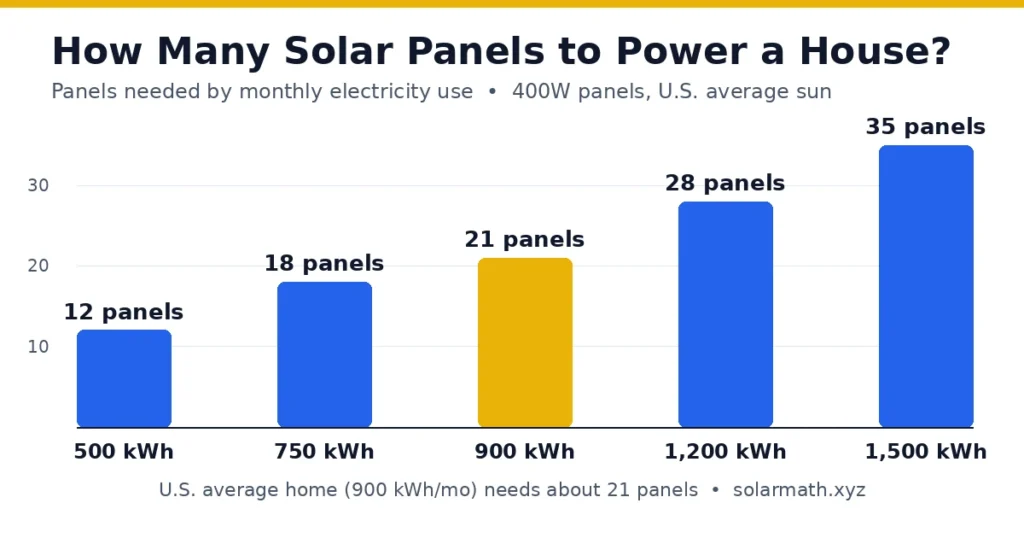
Most U.S. homes need 15 to 25 solar panels to cover the bulk of their electricity use. That is the honest short answer — but only a starting point. A small, efficient home in a sunny state might need as few as 12 panels, while a large all-electric home in a cloudy state can need 35 or more.
The number is not set by the size of your house. It is set by three things you can measure: how much electricity you use, how much sun your roof gets, and how powerful each panel is.
How many panels by monthly electric bill
Your electric bill is the single best sizing tool you own. Find the kWh figure on your last 12 months of bills and match it to this table — standard 400-watt panels, 4.5 peak sun hours a day (the U.S. average), 80% real-world efficiency.
| Monthly use | Daily use | Panels (400W) | System size | Roof space |
|---|---|---|---|---|
| 500 kWh | 16.7 kWh | 12 | 4.8 kW | ~252 sq ft |
| 750 kWh | 25 kWh | 18 | 7.2 kW | ~378 sq ft |
| 900 kWh | 30 kWh | 21 | 8.4 kW | ~441 sq ft |
| 1,200 kWh | 40 kWh | 28 | 11.2 kW | ~588 sq ft |
| 1,500 kWh | 50 kWh | 35 | 14.0 kW | ~735 sq ft |
The U.S. average home uses about 900 kWh a month (10,791 kWh a year, according to the Energy Information Administration), which lands on roughly 21 panels.
A modern panel is about 6.5 ft by 3.3 ft — roughly 21 square feet including spacing — so multiply your panel count by 21 for the roof area. Fire codes also require setback pathways along ridges and edges.
The formula, step by step
If you want your exact number instead of a table row, here is the calculation installers use:
Step 1 — Daily use. Divide your monthly kWh by 30. A 1,200 kWh month is 40 kWh a day.
Step 2 — What one panel makes. Multiply the panel’s wattage by your peak sun hours, then by 0.80 for real-world losses. A 400-watt panel at 4.5 peak sun hours makes about 1.44 kWh a day (0.4 × 4.5 × 0.80).
Step 3 — Divide. Daily use ÷ daily output per panel = panels. 40 ÷ 1.44 ≈ 28 panels.
Step 4 — Round up. Always round up to a whole panel. Panels degrade slowly (about 0.5% a year) and your usage may grow if you add an EV or a heat pump later, so a little headroom is wise.
Peak sun hours are the number that most people get wrong. It is not the hours of daylight — it is the equivalent hours of full-strength sun. Phoenix averages about 6.5, Atlanta about 4.5, Seattle about 3.5. Your exact figure comes from your ZIP code — the free NREL PVWatts tool gives it in minutes.
Worked example: a Texas home with a $180 bill
Take a Texas household paying $180 a month at 15¢ per kWh — 1,200 kWh a month, or about 14,594 kWh a year once seasonal variation is counted.
Texas is sunny — about 5.5 peak sun hours a day — so each panel produces more than the national average. Running the numbers:
- Daily use: 1,200 ÷ 30 = 40 kWh a day
- One panel’s daily output: 0.41 kW × 5.5 sun hours × 0.80 ≈ 1.8 kWh
- Panels: 40 ÷ 1.8 ≈ 23 panels
- System size: 23 panels × ~410 W = 9.4 kW
- Roof space: 23 × 21 sq ft = 483 sq ft
- Annual production: 14,594 kWh
- Installed cost: $26,876 (about $2.86 per watt, inside the typical U.S. range of $2.50–$3.10 per watt)
- Payback: 10.8 years
- 25-year savings: $74,392, for a 25-year net gain of $47,602 after the system cost
Notice what the example shows: the same 1,200 kWh a month needs 28 panels at the U.S. average sun level but only 23 in Texas. Location is worth five panels — roughly $2,900 of hardware. That is why a quote that never asks for your address is a quote to be suspicious of.
One important 2026 note: the federal 30% residential solar credit (Section 25D) expired on 31 December 2025. The $26,876 above is the full price — no federal credit subtracted. Some state, local, and utility incentives still exist, but any 2026 quote that still deducts 30% for a federal credit is using outdated math.
Four things that change your panel count
Panel wattage. A 450-watt panel does the work of about 1.1 standard 400-watt panels. Higher wattage cuts the panel count, not the system size — you still need the same 9.4 kW, just in fewer, larger modules. That matters when roof space is tight.
Roof direction and shade. A south-facing roof in the northern hemisphere is the gold standard. East- or west-facing arrays still work but produce roughly 10–20% less. Shade is harsher still: a tree shading one corner of the array for part of the day can cut that section’s output sharply.
How much of the bill you want to cover. You do not have to offset 100% of your use. Many homeowners size for 80–90% and let the grid cover the rest — especially where net metering pays less for exported power than the retail rate.
Future loads. An electric vehicle adds roughly 2,500–4,500 kWh a year — about 5 to 9 extra panels. A heat pump replacing gas heat adds more. If either is on your two-year plan, size for it now: adding panels later costs more per watt.
What a system like this costs
At $2.50–$3.10 per watt installed, a 9.4 kW system runs roughly $23,500 to $29,140 before any state or local incentive. The Texas example’s $26,876 sits in the middle of that band. Price per watt falls as systems get bigger and rises with complex roofs, battery additions, or premium panels.
Frequently asked questions
How many solar panels does the average house need?
About 15 to 25 panels of 400 watts each, for a system of roughly 6–10 kW. The U.S. average home uses about 900 kWh a month, which works out to around 21 panels.
How many solar panels do I need for a 2,000 sq ft house?
Roughly 18 to 28 panels, depending on the electric bill. A 2,000 sq ft home typically uses 900–1,200 kWh a month — but two identical houses can differ by half in electricity use, so the bill matters more than the floor plan.
Can I just add more panels later if I underestimate?
Usually yes, but it costs more per watt than including them now, and your inverter may need upgrading if it cannot handle the extra capacity. It is cheaper to size generously once than to expand later.
Find your exact number: enter your monthly bill and your state into the SolarMath panel count calculator — it works out your system size, panel count, roof space, and cost in seconds.